Next project
How I redesigned manual processes and gave the administrative team more autonomy.
90%
reduction in operational time
80%
reduction in administrative workload
80%
of attendance records captured digitally
CLM Music School is an institution with a strong social impact, offering free music education through a structured three-year program. With more than 160 active students and a team of teachers and coordinators, its operation relied heavily on manual processes, spreadsheets, and paper documents.
Despite the quality of its educational program, the school faced operational limitations that affected efficiency, organization, and scalability.
This project grew from the need to transform the school’s operation into a centralized digital system while keeping it simple for users with different levels of technological experience.
The CLM MVP has two key audience segments:



Teachers
Teachers need a fast and simple way to record information without disrupting their classes.
Administrative staff
The administrative staff needs to manage the school more efficiently and keep daily operations better organized.
The main goal was to reduce the school’s operational complexity:
Improve internal communication
Reduce reliance on informal communication by keeping relevant information within the system, making collaboration between administrative staff, teachers, and coordinators clearer and more efficient.
Digitize attendance and records
Replace manual tracking with a simple digital flow that allows teachers to record attendance in up to 15 seconds, improving consistency and reducing delays.
Centralize academic and administrative data
Bring all school information into one place, eliminating fragmented data across spreadsheets, paper documents, and separate tools while providing fast and reliable access.
Prepare the school for growth
Create a structured foundation that allows the school to scale with greater control, less rework, and better data-informed decision-making.
Before the system, attendance was tracked through spreadsheets. Inconsistent updates and delays that could last for weeks created constant rework for the administrative team and made the data unreliable.
Attendance can now be recorded through a simple and intuitive flow, allowing teachers to complete roll call in just a few seconds—up to 15 seconds per class.
This change reduced operational time, gave teachers more autonomy, and provided the school’s management team with greater control and visibility.

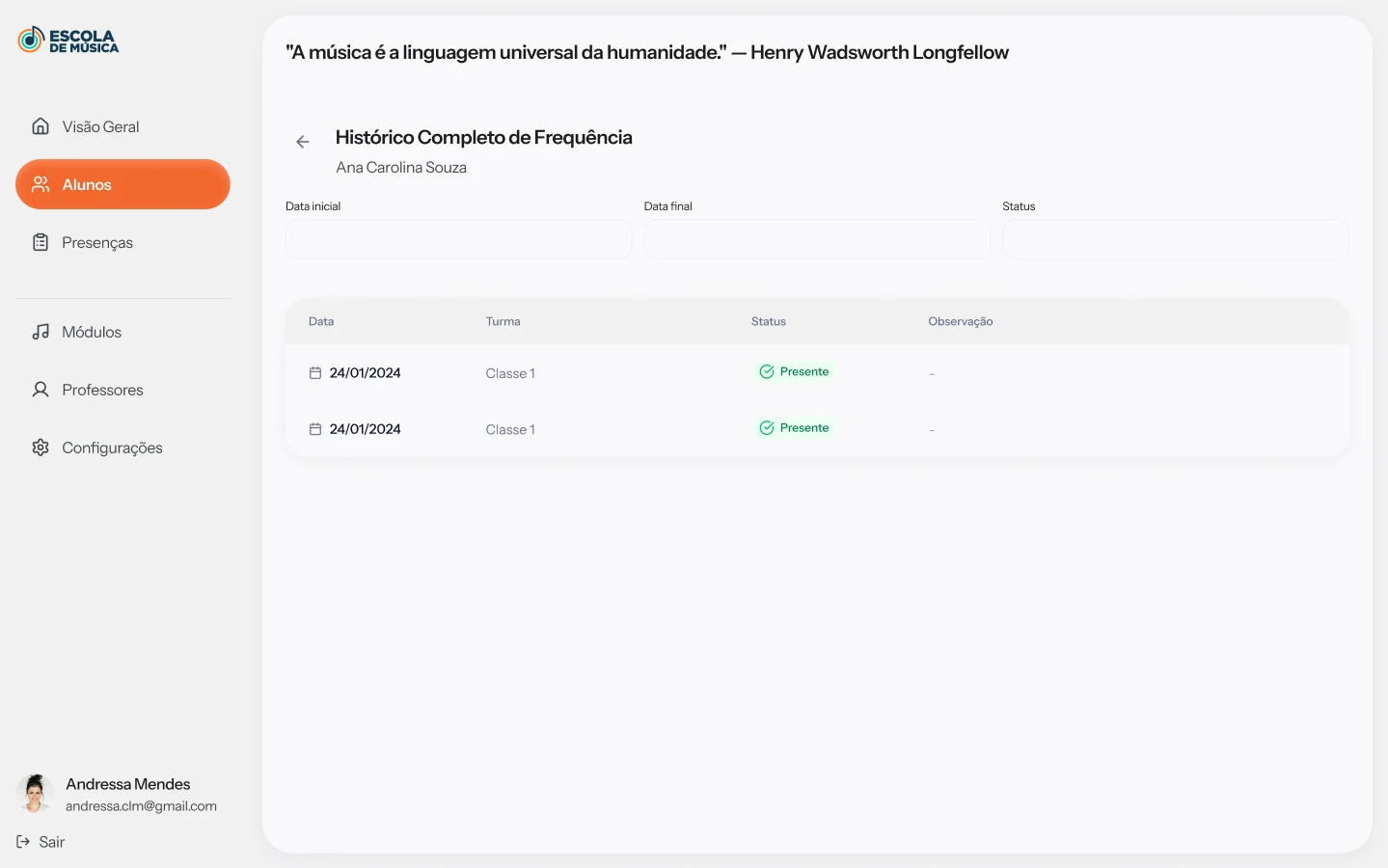
The student page was designed as the central place for accessing all relevant information about each student. It provides a complete view of their academic and administrative history, bringing personal information, documents, attendance, and records into one place.
The main goal of this screen was to reduce the time spent searching for information and eliminate data fragmentation.



One of the main bottlenecks in the administrative process was manually registering students from paper forms and printed documents. In addition to taking time, this increased the risk of typing errors, inconsistencies, and operational rework.
To solve this problem, I proposed an OCR-assisted document scanning flow that automatically extracts information from documents and forms submitted by the school.


From the beginning, I identified the need for a solid foundation that would allow the product to evolve consistently while avoiding rework and isolated decisions for every new screen.
Use the sidebar to navigate between sections
During development, I planned usability tests with different user profiles—administrative staff and teachers—to validate the simplicity of the flows and the efficiency of the interactions.
The hypotheses tested were:
Teachers
Teachers can record attendance without friction or difficulty.
Administrative staff
Administrative staff can reduce the time spent reviewing records.
Both
Users can understand the flow without training.


Throughout the project, I used AI tools as strategic support to speed up discovery, documentation, prototyping, and development, while keeping refinement, validation, and final decisions under my direction.
AI was used as an extension of my workflow, helping organize information, explore solutions, and improve productivity across different stages of the product.
ChatGPT
Documentation and structure
Design System
Storybook
Ideation & prototyping
Figma Make
Front-End
Codex
With the possibilities AI brought to the process, I also explored visual and structural experiments. One of them was an integrated light and dark mode using variables and tokens defined from the beginning of the design system.
This structure made it possible to quickly adapt different themes and visual scenarios without compromising consistency, scalability, or interface maintenance.
Current project status
The project is currently in the prototyping and validation stage with real users. I am conducting usability tests with the school’s team to identify friction points, validate hypotheses, and refine the flows before implementing the MVP.

© Andressa Mendes 2026. All Rights Reserved
