Next project
Managing personal health is still fragmented, complex, and often inaccessible. Medical information is scattered across test results, appointments, apps, and the patient’s own memory, making continuous tracking and everyday decision-making more difficult. Although this is a common problem, it becomes even more challenging during stages of life when care is more frequent, emotional, and essential.
For new mothers, especially first-time mothers, daily life begins to include a range of new responsibilities, such as vaccinations, pediatric appointments, medication management, and tracking their child’s development.
At the same time, the number of people in the “sandwich generation” continues to grow. These are adults who care for both their children and aging parents. In this context, health management is no longer individual it becomes a family responsibility involving multiple medical histories, treatments, and parallel care routines.
Vivama is designed for people at different stages of life.


New mothers
First-time mothers who need to manage vaccinations, appointments, medications, and their child’s development while often dealing with uncertainty and information overload.
Sandwich generation
Adults responsible for multiple family members who need to manage different medical histories, treatments, and care routines at the same time.
People with chronic conditions
People who need to monitor conditions such as diabetes or hypertension, maintain frequent records, and follow ongoing treatment routines.
Caregivers and family members
Family members responsible for someone else’s health who need quick access to organized and up-to-date medical information.
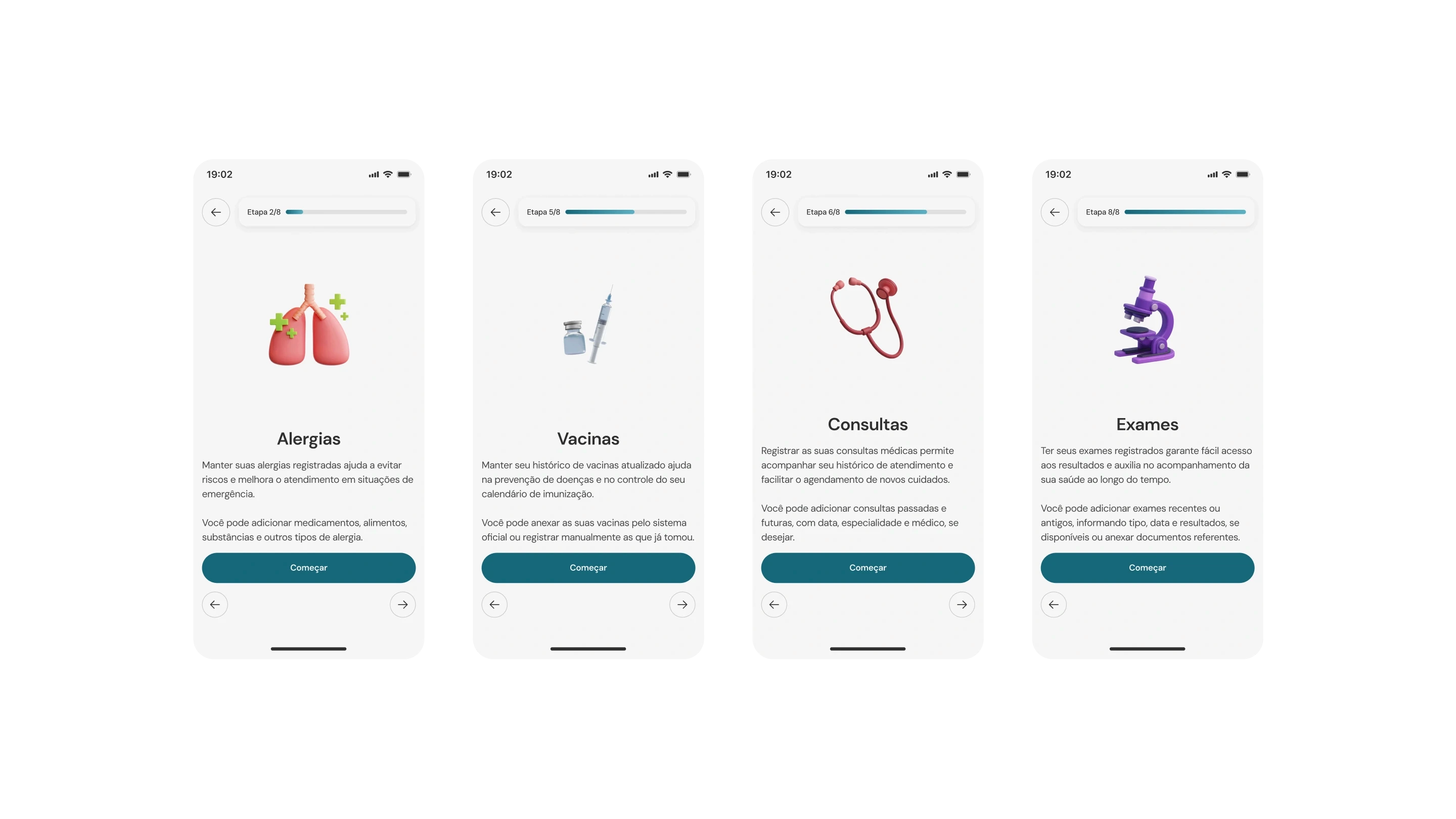
Vivama aims to make health management easier through:
Smart centralization
Bringing medical history, test results, appointments, and medications into one organized and accessible experience.
Continuous tracking
Making long-term monitoring easier and encouraging users to keep their records relevant and up to date.
Access and sharing
Allowing health information to be easily accessed and shared with family members and healthcare professionals.
Proactive prevention
Encouraging preventive habits through reminders, insights, and continuous tracking.
One of Vivama’s main differentiators was replacing traditional inputs with a natural language system.
Instead of completing rigid forms with multiple fields, users interact through dynamic text inputs, creating a more fluid, human, and adaptive experience.
This approach reduces friction, simplifies complex flows such as recording health information, and makes the interface feel more like a real conversation, supporting the product’s AI-driven experience.

Before — Version 1

After — Current version
AI is treated as a personal assistant that guides users throughout the experience.
I defined standards for the AI’s behavior, including its tone of voice, personality, response structure, user feedback, and how it guides interactions across different flows.
The AI identity, represented by the assistant “Vi,” was also integrated into the system with visual and behavioral guidelines that ensure consistency throughout the experience.
Visual representation of Vi
Chat with Vi
From the beginning, I identified the need for a solid foundation that would allow the product to evolve consistently while avoiding rework and isolated decisions for every new screen.
Grids
Typography

Iconography

Color palette

Vivama also allows users to track and organize the health of dependents within the same experience.
Family profiles make it possible to manage different care routines in one centralized place, keeping information organized and accessible.
This flow is especially relevant for new mothers, caregivers, and people who need to manage the health of their children and aging parents at the same time.


Vivama Website
The Vivama website was designed as the main connection point between the product and its users, translating a complex solution into a clear, accessible, and conversion-focused narrative.
Current project status
Vivama is currently in continuous development, with beta testing being conducted with a group of users interested in the product.
We are currently conducting usability tests and monitoring user behavior during real-world use to identify friction points, areas of uncertainty, and potential issues in the experience.
This process has been essential for validating product decisions, refining flows, and evolving the experience iteratively, ensuring that the final product is useful, intuitive, and aligned with user needs.

© Andressa Mendes 2026. All Rights Reserved
